

Reference
Choose your value factors: an IVSB-aligned set is now in the software
The software now carries a second value factor set, aligned with the value factors the IVSB has published. What changes when you switch, the three choices that shape every number, and the full methodology note.
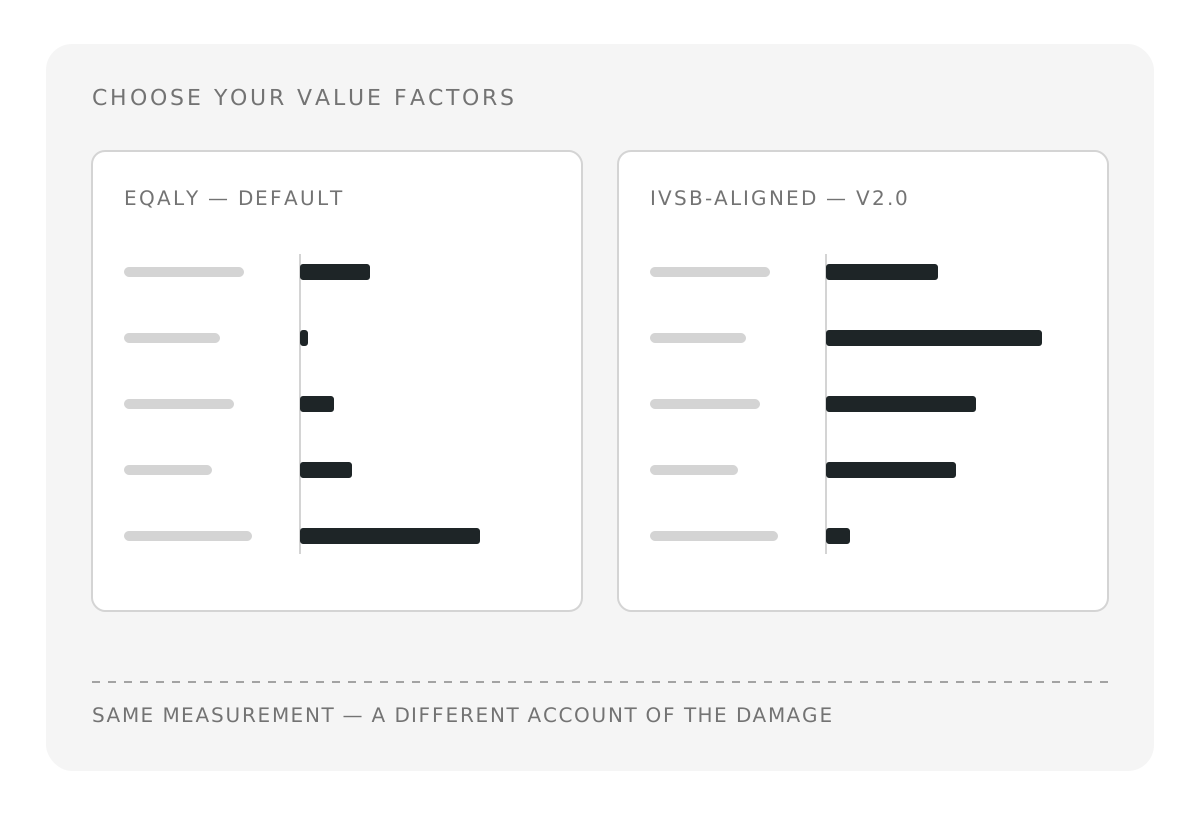
Impact valuation has had a standardisation problem for as long as it has existed. Two organisations can measure the same tonne of CO2e, the same cubic metre of water, the same workplace injury, and report societal values that differ by an order of magnitude, because they picked different value factors from different sources built on different logics. The Impact Value Standards Board, hosted by the Capitals Coalition and building on the earlier IFVI and VBA work, is the field's most serious attempt to fix that.
Disclosure: Samuel Vionnet, founder of Valuing Impact and co-founder of the platform, holds a seat on the IVSB. This post describes published IVSB material and the choices made in adapting it to the software. It does not report board discussions and does not represent the IVSB's views.
Updated 6 October 2026 for version 3.0 of the set, which rebases the twelve indicators the IVSB has not reached. The figures below compare version 3.0 with version 2.9 of the default set.
From today, you can run your assessments on the IVSB's factors inside the platform.
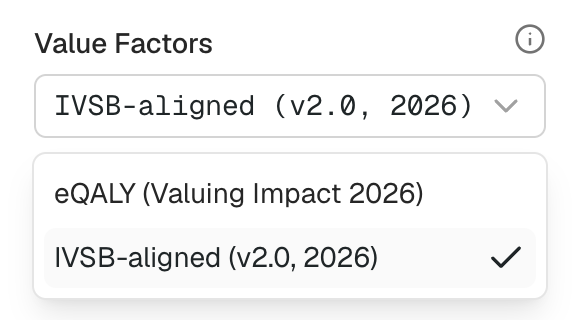
The software now carries a second value factor set, aligned with the value factors the IVSB has published. You select it per project, and you can switch a finished project from one set to the other: the platform re-values the model rather than making you rebuild it. The default remains the eQALY value factor set published by Valuing Impact, a decade in use across thousands of assessments. What changes when you switch is not how impact is measured. It is the price society puts on each outcome.
What changes, and what does not
The valuation logic is untouched. Pathways, impact drivers, outcomes, the single wellbeing unit, the citations, the audit trail and the exports all behave exactly as before. Only the conversion layer moves: the factors that turn physical flows and monetary outcomes into societal value.
That separation is the whole point. Because assessment and valuation are kept apart in the model, swapping the factor set is a setting rather than a project. You keep the work you already did on activities, data and evidence, and you see what a different valuation lens does to the answer.
The set covers the same 266 geographies as the default, expressed in 2025 US dollars, and it is versioned. This is version 3.0, built on the IVSB Global Value Factors Database version 4, published on 18 June 2026, and on version 2.9 of the eQALY set. Version 3.0 ships with the new version of the platform; until then, projects run on version 2.0.
💡 Try it in one minute: Clone an existing project, switch the clone to the IVSB set, and put the two results side by side.
The set is intermediate, and it says so
The IVSB is publishing topic by topic. Greenhouse gases, water consumption and occupational health and safety are final. Air pollution, water pollution, land use and waste are interim or draft. Wages are being reworked into a Core Working Conditions factor. Several things the software values every day have no IVSB methodology at all yet.
A set that only used published IVSB factors would therefore be incomplete, and an incomplete set silently drops impacts rather than valuing them differently. So every indicator gets one of four treatments, and the treatment is stored against the factor, so the basis of every number stays on the record:
| Treatment | What it means | Count |
|---|---|---|
| Adopted | The IVSB country factor is imported directly, with unit conversion and inflation to 2025 prices | 5 |
| Derived | Built from IVSB substance-level values using the characterisation factors the software already applies | 2 |
| Rebased | The IVSB has no factor. The default set's inputs are kept, revalued with the IVSB value of a life year and a money conversion of one, and labelled as an interim value | 12 |
| Modelled | No factor imported. The activity, waste being the main case, is modelled and the resulting flows valued with the factors above | — |
Seven of nineteen environmental indicators come from the IVSB. Climate change, water consumption, freshwater eutrophication, particulate matter and land use are adopted directly. Human toxicity, cancer and non-cancer, are derived by mapping the IVSB's substance-by-substance water pollution values through characterisation factors, which is a Valuing Impact construction the IVSB has not endorsed, and both are labelled as derived wherever they appear.
The remaining twelve represent the gap list. They cover ecotoxicity, acidification, ozone formation and depletion, radiation, plastics and resource depletion, and the IVSB has not reached any of them yet. Version 2.0 kept the default values for these, which still carried the default set's wellbeing conversion and its value of a life year. Version 3.0 rebases them on the IVSB set's own terms. Where the default starts from a damage cost (CE Delft's prices for ecotoxicity, acidification, marine eutrophication, ozone damage to ecosystems and resource depletion, and the Beaumont et al. estimate for marine plastics), that cost is taken at face value. The three health effects, ozone depletion, ionising radiation and ozone damage to health, are valued at the IVSB's value of a life year. No factor in the set now carries the default's conversion. Each is named with its status in the methodology note.
Outside the LCA indicators the picture is the same. Occupational health and safety follows the final IVSB methodology, valuing incidents as fractions of the value of a statistical life plus healthcare cost. Wages are counted at face value, which is the IVSB's own current guidance, while the earlier wages methodology is being replaced by the Core Working Conditions factor. Taxes and education have no IVSB methodology at all, so they are counted at face value too. Wage inequality sits on the IVSB workplan and is not modelled by either set today.
Three choices that shape every number
Fitting a published factor database to a working valuation engine means making calls the source material leaves open. Three of them matter more than all the others, and the methodology note explains each in full.
A life year is worth $95,846. The default set values a healthy life year at $62,082, derived from global income per capita on the WHO-CHOICE convention. The IVSB starts from a value of a statistical life in an OECD meta-analysis and divides by remaining life expectancy, which lands at $95,846 in 2025 prices. About 54 per cent higher, by a completely different route. Most health and environmental damage eventually reduces to this number, so it moves a lot.
Money is counted at face value. When an impact first appears as money, a damage cost, a wage, a tax payment, the default set converts it into wellbeing using a country factor reflecting what a dollar actually achieves at that income level. The IVSB treats a dollar of damage as a dollar of societal cost. Under the IVSB set the software switches that conversion off entirely. This is the single most important compatibility choice in the exercise, because leaving it on would produce numbers belonging to neither system. The visible consequence is that wage, tax and training results flatten across geographies, and the flattening is largest for operations in low-income countries.
One value of life, applied everywhere. The June 2026 database publishes a Global and a Local perspective. The set uses Global. The Local perspective scales the value of a life year by income, which values the same fatality in Afghanistan at 2.6 per cent of its value in the United States, so a company reports less harm for identical physical damage simply because the people affected are poorer. Global matches the equal-value-of-life principle the software already applies everywhere else, and the IVSB's own occupational health and safety methodology argues for it. The income ratio is carried in the dataset, so a local variant can be produced if a client requires one.
Two of those choices pull in opposite directions on equity, and it is worth naming rather than leaving to be noticed. Applying one value of life everywhere means identical physical harm is valued identically wherever it falls. Counting money at face value means a dollar of wages counts the same in Malawi as in Switzerland, where the default set treats it as buying more wellbeing in Malawi. So the set holds a strict equity line on life and accepts face value on income. The first is a principle, the second is a compatibility constraint, and knowing which way each pushes matters more than the fact that they differ.
What actually moves
The five indicators below illustrate the range. All nineteen, with their treatment and status, are in the methodology note.
| Indicator | World, default | World, IVSB | Change |
|---|---|---|---|
| Climate change (USD/kg CO2e) | 0.180 | 0.262 | ×1.5 |
| Water consumption (USD/m³) | 0.122 | 2.57 | ×21 |
| Land use (USD/m²·a) | 0.091 | 0.570 | ×6.3 |
| Freshwater eutrophication (USD/kg P-eq) | 7.93 | 94.5 | ×12 |
| Particulate matter (USD/kg PM2.5-eq) | 45.1 | 21.1 | ×0.47 |
Water rises steeply because the default factor counted the cost of replacing water, while the IVSB factor also counts lost ecosystem services, malnutrition when agriculture loses water, and water-borne disease following reduced access. Land use rises because the IVSB values the full loss of ecosystem services across the biome rather than soil functions alone. Particulate matter goes both ways: the IVSB's peri-urban value is about half the default for the world and the United States, after the June 2026 database revised the IVSB air pollution values down by 40 per cent in real terms, but nearly three times the default for India, because the two sets regionalise the factor differently.
The two toxicity indicators are left out of the table because they behave unlike the rest. The default set prices them with two global constants, the same everywhere, while the derived factors are country-specific and range from $0.002 to $0.45 per unit, following the IVSB exposure model in which countries with extensive drinking-water treatment show much lower values. Toxicity results therefore vary between geographies in a way they did not before, and this is the factor carrying the most uncertainty in the set.
A worked example makes the aggregate effect concrete. A site in India releasing 1,000 tonnes of CO2e, consuming 5,000 cubic metres of water, occupying two hectares of land for a year and emitting 50 kilograms of PM2.5 comes to a societal cost of $184,340 under the default set and $364,555 under the IVSB set. Roughly twice as large, driven in roughly equal measure by water and climate. Water carries most of the surprise, because India is water-scarce and the IVSB prices the cost of securing future supply.
The direction is not uniform, which is the useful part. At the world level thirteen indicators go up and six come down, particulate matter by half. The twelve rebased indicators flatten across geographies the way wages and taxes do: marine eutrophication costs $18.31 per kilogram of nitrogen everywhere under the IVSB set, against $2.56 in the United States and $40.63 in Nigeria under the default set. A factor set is not a dial you turn up or down. It is a different account of what the damage was worth.
Why we think this is good for the field
Standards get better when people run them against real portfolios and report what breaks. Until now, testing the IVSB factors at scale meant building a parallel model by hand, which almost nobody was going to do. It is now a dropdown.
That matters in three directions. Preparers can state alignment with published IVSB factors where those factors exist, and back it with a per-factor account of exactly which numbers come from a final IVSB methodology, which from an interim or draft one, which are derived, and which are rebased defaults. That account is published in full in the methodology note at the end of this post, so it can be cited or reproduced in a report annex. Investors and auditors get a result they can interrogate against a public source rather than a proprietary one. And the standard-setting process gets something it currently lacks in volume: operational evidence from real assessments about where the factors behave sensibly and where they do not.
We found two things worth reporting just in building the set. The value factor database still carried exposure-draft water values, so water was rebuilt from the final methodology's national table, moving India from $3.11 to $17.75 per cubic metre. And the toxicity derivation turned out to be highly sensitive to the emission compartment, with freshwater-only and seawater-only derivations differing by up to a factor of five, so both are pooled. Both are documented in the methodology note, alongside the checks that confirmed the rest of the build against the IVSB's published anchors.
That is the kind of finding that only surfaces when someone tries to use a factor set in production. We would like a lot more of it, from a lot more people.
One more thing worth saying plainly: there is no lock-in. The architecture treats the factor set as a selectable layer, not a hard-coded assumption. eQALY remains the default because it is comprehensive and operational today. The IVSB set is reissued whenever the IVSB publishes a new database or finalises a topic, each reissue carrying a changelog, with waste, land use and the Core Working Conditions factor the next expected changes. Any future published set can be added the same way.
Reading the results
An IVSB-set result is aligned with the IVSB's published factors as far as they go. It is not a conformance claim, and no such claim is available while the methodology suite is still being built. The accurate description is a valuation using IVSB factors where published, with named treatments for everything else. Every factor in the set carries its source and status in the dataset, and the methodology note below lists the treatment and status of all nineteen indicators, so the disclosure can be written straight from it.
The same applies to comparing two results. A number under the IVSB set and a number under the default set are answers to different questions, not a right answer and a wrong one. The comparison is informative about how much your conclusion depends on the valuation lens, which is usually worth knowing before a capital allocation decision rests on it.
Get help choosing
If you want help deciding which set fits your context, your reporting obligations or your investors' expectations, write to Samuel at sv@impactaccounting.ai. If you are already on the platform, clone a project and switch the clone, and see for yourself how much of your result is method and how much is measurement.
Not on the platform yet? Request access and test it on a name you know.
The methodology note
Everything above is documented in full in the IVSB value factors methodology note: every unit conversion, parameter and constant, the toxicity mapping and its three qualifications, the country gap-filling rules, a worked example, and the treatment and status of all nineteen indicators one by one. The IVSB's own published methodologies and value factor database are at capitalscoalition.org.