
Explanation
Screening a holding against SFDR
Contribution, do no significant harm, good governance — three tests, each with a figure, a threshold and a reason you can point at. A walk through the SFDR & Article 9 screen on an early-stage holding, and why "does not qualify" is the most useful thing it produces.
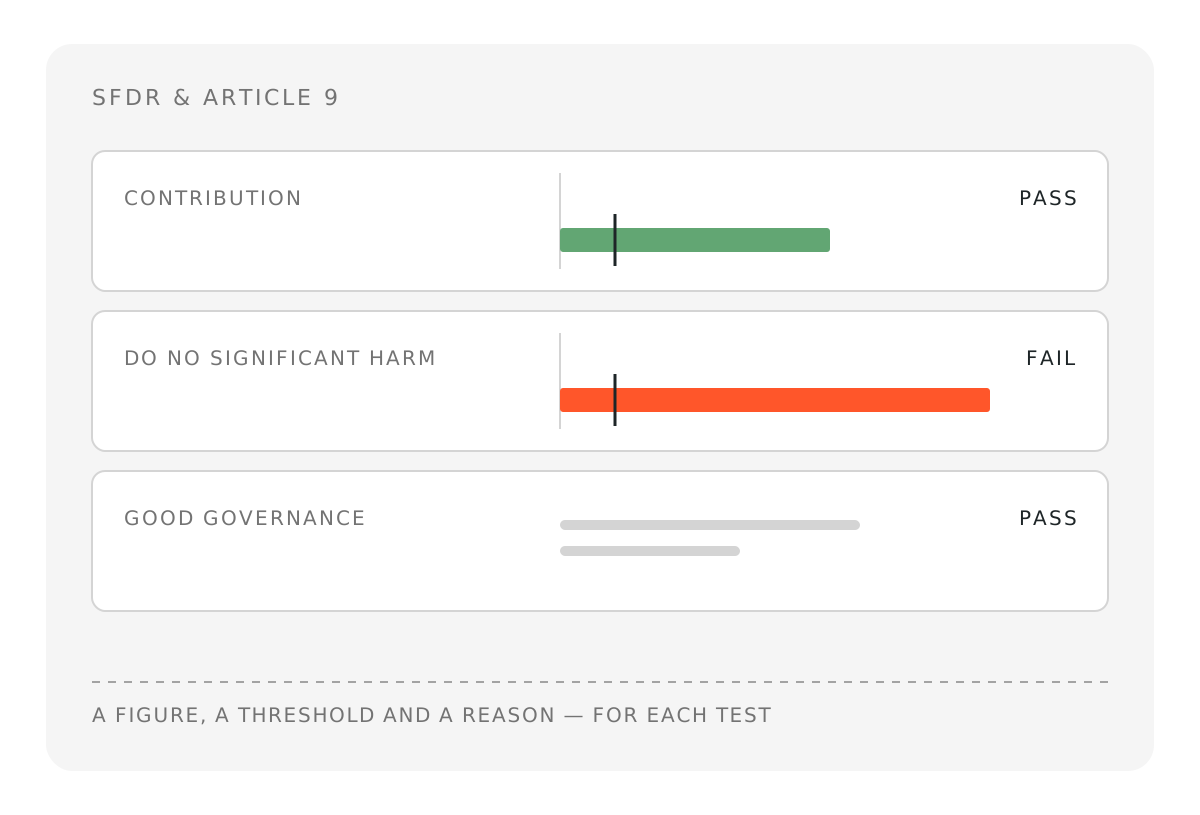
Deciding whether a holding counts as a sustainable investment is a three-part test, and in practice only one part usually has numbers behind it. Contribution gets argued from the company's own reporting. Do no significant harm gets a vendor score and a paragraph. Good governance gets a memo. The position then goes into the fund and the reasoning sits in a file nobody reopens until an auditor asks.
The SFDR and Article 9 section runs all three against a monetised impact model, so each one produces a figure, a threshold and a reason you can point at. This walks through it on Nutris, an early-stage fava-bean protein producer with about 10.1 million dollars of revenue, screened against a fund whose stated objective is to regenerate biodiversity.
What the section gives you
Open the assessment, go to Insights, then Regulatory, then SFDR & Article 9. Two things sit there, and they do different jobs.
The first assembles evidence, presenting the mandatory principal adverse impact indicators and marking how far the model can take each one. The second reaches a conclusion, testing the holding against the fund's configured rules. Neither classifies a product. Both work on a single holding, and the fund-level judgement stays with the financial market participant.
Reading the PAI table
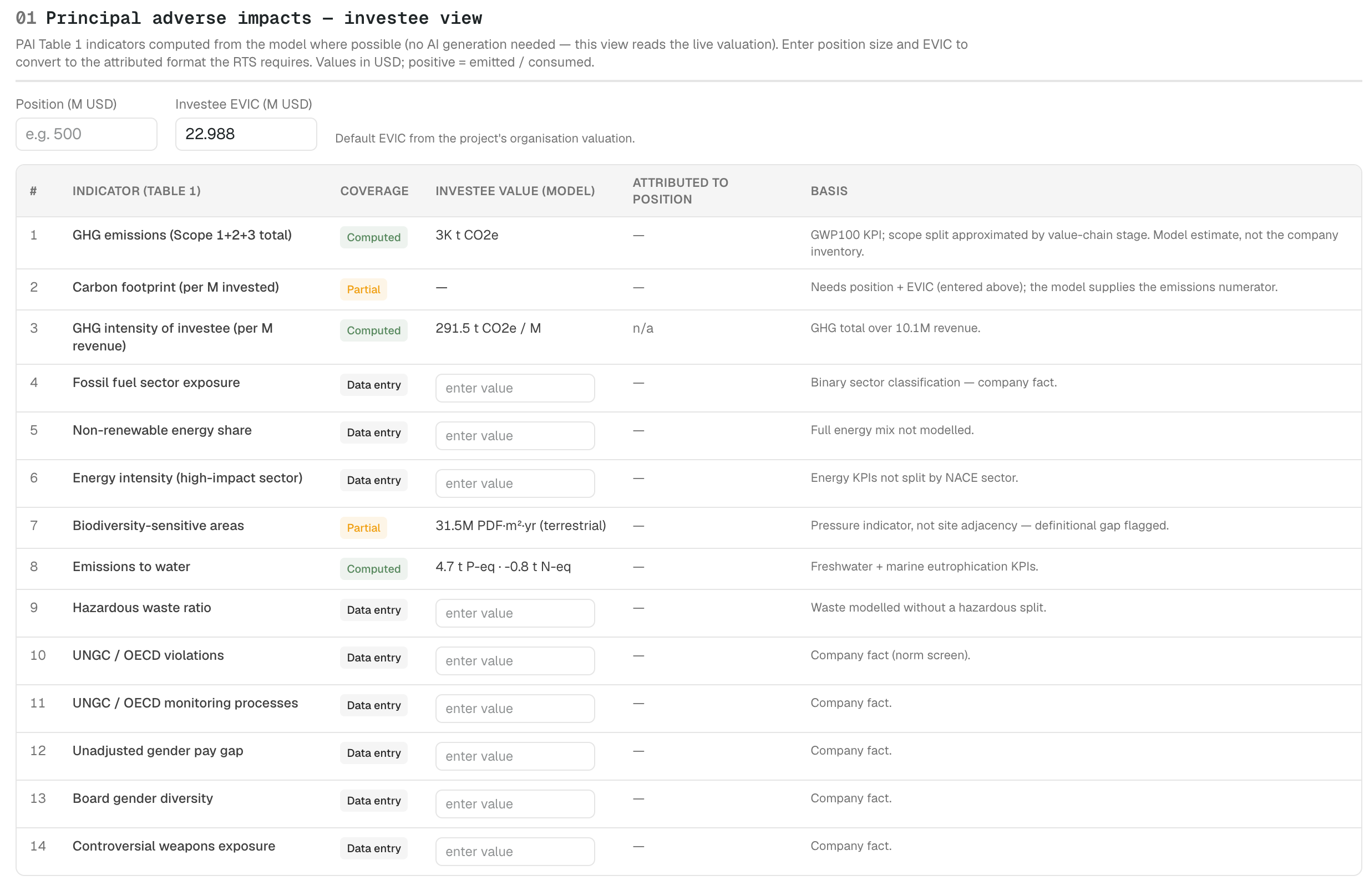
Fourteen Table 1 indicators, each labelled by how far the valuation can carry it. Three are computed, two are partial, and nine need company data.
The three computed indicators read straight from the live valuation with no generation involved. Total greenhouse gas emissions come to about 3,000 tonnes of CO2 equivalent, intensity to 291.5 tonnes per million of revenue, and emissions to water to 4.7 tonnes of phosphorus equivalent alongside minus 0.8 tonnes of nitrogen equivalent. That negative is not a typo. The table follows the convention that positive means emitted or consumed, so a negative marine figure means the activity avoids more than it causes. Worth knowing that this is a modelling convention rather than a disclosure one. A PAI table submitted under the technical standards reports emissions, not emissions net of what was avoided elsewhere, so a negative value needs converting or explaining before it goes near a filing.
Each computed row also carries its own caveat. The emissions figure is described as a model estimate rather than the company inventory, with scopes approximated by value-chain stage. That distinction matters if the number is going anywhere near a disclosure.
Two kinds of gap
The two partial rows look alike and are not.
Carbon footprint per million invested is partial only because the position size has not been entered. The model already supplies the emissions numerator, so the gap closes the moment someone types a number into the field at the top. The EVIC is already there at 22.988 million dollars, defaulted from the project's own organisation valuation.
Biodiversity-sensitive areas is partial for a different reason. The model has 31.5 million PDF square-metre-years of terrestrial pressure, which is real evidence, but the regulation asks whether operations sit in or near a biodiversity-sensitive area. Pressure is not adjacency. No amount of data entry closes that one, and the table says so rather than letting a plausible number stand in for the right one.
The nine remaining rows split the same way. Three are things the model has not been built to carry, namely the full energy mix, energy intensity split by NACE sector, and a hazardous fraction of waste. Six are company facts that no impact model could produce, covering fossil-fuel sector classification, Global Compact and OECD violations and monitoring, gender pay gap, board diversity and controversial weapons.
That taxonomy is the useful part. A missing indicator is either one field away, one modelling decision away, or a company disclosure you have to go and get, and knowing which is which turns the table into a work list rather than a set of blanks.
Enter a position and the attributed column fills, converting investee values into the per-position format the technical standards require. Not everything scales that way. Intensity shows n/a rather than a dash, because a ratio is a property of the company and does not divide down with a holding.
The table returns no overall verdict, and that is deliberate. Partial and missing rows are data-quality and due-diligence items rather than failures.
Reading the eligibility screen
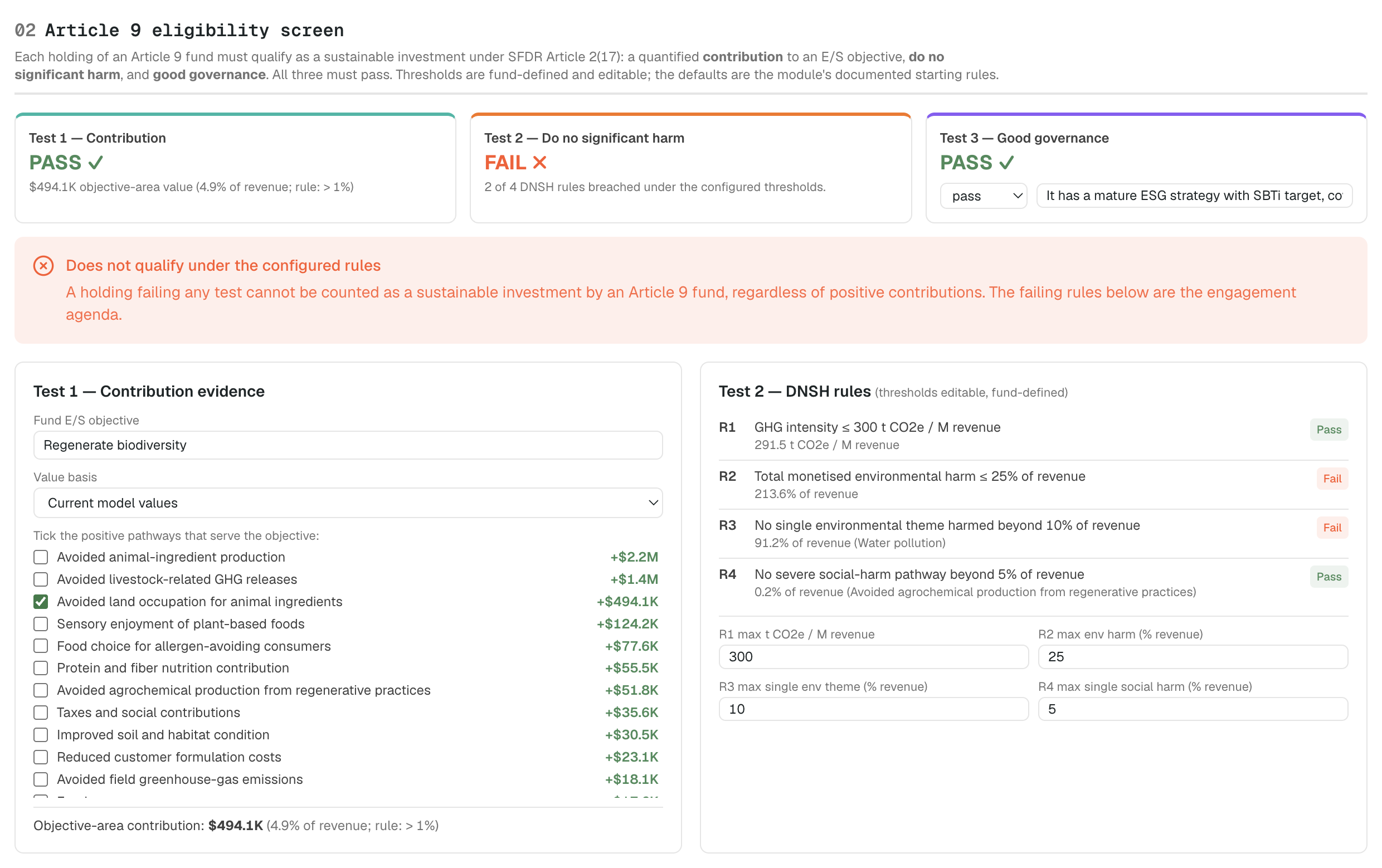
Three tests, all of which must pass. Nutris clears contribution and governance and trips two of four do-no-significant-harm rules, so under these thresholds the screen reports that it does not qualify. Hold that conclusion lightly for a moment, because the reason turns out to be more interesting than the verdict.
The contribution figure is a choice
Contribution passes at 494,000 dollars, which is 4.9 per cent of revenue against a fund rule of more than 1 per cent. Neither the ratio nor the rule comes from the regulation. SFDR prescribes no societal-value-to-revenue threshold at all, so the 1 per cent is the fund's, in the same way the DNSH limits below are.
How that figure is built matters more than the figure. The model offers a long list of positive pathways and the screen asks the analyst to tick the ones that serve the stated objective. Avoided animal-ingredient production sits at the top at 2.2 million dollars. Avoided livestock-related greenhouse gas releases follow at 1.4 million. Below them come sensory enjoyment of plant-based foods, allergen-avoiding food choice, protein and fibre nutrition, taxes and social contributions, and several more.
Exactly one box is ticked. Avoided land occupation for animal ingredients, at 494,000 dollars, because land occupation is what bears on regenerating biodiversity.
Tick everything and the contribution multiplies and the test clears by a wide margin. It would also mean nothing, because avoided greenhouse gas emissions and tax contributions do not regenerate biodiversity, whatever else they do for the world. The regulation asks for contribution to a stated objective, not for general merit, and the screen is built to make that distinction visible rather than convenient.
So the contribution figure is not a property of the company. It is a claim about which of a company's positive impacts serve one named objective, and it is worth exactly as much as the discipline behind the ticking. It should never travel without the objective and the selection attached to it.
Where the harm sits
Greenhouse gas intensity passes at 291.5 tonnes per million of revenue against a limit of 300, which is a narrow margin worth watching. Severe social harm passes comfortably at 0.2 per cent of revenue against a limit of 5.
The two failures are total monetised environmental harm at 214 per cent of revenue against a 25 per cent rule, and a single environmental theme at 91 per cent of revenue against a 10 per cent rule, driven by water pollution.
The first thing to notice is that the failure has an address. Not an amber flag on an ESG dashboard, but water pollution at roughly 9 million dollars of monetised harm, which is a specific and actionable thing to put to a company.
Read the ratios against the company's stage
The second thing to notice is the denominator.
Every DNSH rule here is a ratio to revenue, and Nutris has about 10.1 million dollars of it. That is a young plant-protein producer some way short of scale, and physical footprint arrives well before commercial maturity does. Fields are farmed, nutrients run off and processing runs at subscale yields long before pricing, volume and margin catch up. Measuring externalities against a small and rapidly growing revenue line will produce a high ratio almost by construction, and the same operation at three or five times the revenue would report a very different percentage without a single thing changing on the ground.
That does not make the result wrong. The screen computed what it was configured to compute, and 214 per cent against a 25 per cent rule is what those thresholds return on this company today. But it means the result is a statement about a threshold meeting an early-stage business, rather than a settled judgement about the holding. On trajectory, a company whose entire product thesis is displacing animal agriculture looks considerably more like a sustainable investment than this snapshot suggests, and a fund willing to hold companies at this stage needs thresholds that say so.
There are a few honest ways to handle it. Set stage-appropriate thresholds and record why, which is a methodology decision the fund can defend. Look at the ratio's direction across successive valuations rather than its level in one year. Or use a denominator less sensitive to commercial maturity than revenue for early-stage holdings. What is not defensible is inheriting a default calibrated for large caps, applying it to a scale-up, and reporting the output as a finding.
The four thresholds are editable on the same screen, and the module describes its defaults as documented starting rules rather than statutory limits. They are a starting point, and the invitation to change them is explicit.
Governance stays a human judgement
The third test is a dropdown and a text box. The analyst selects pass, pending or fail and writes the reasoning, here a pass supported by a note on a mature ESG strategy with a science-based target.
Nothing there is modelled, deliberately. Management structures, employee relations, remuneration and tax compliance are matters of documentary evidence rather than impact pathways. What the screen adds is to make the judgement explicit, attributable and stored beside the other two tests instead of living in a separate memo. Pending is not a pass, and a holding left pending does not qualify.
What the screen is for
A result that reads "does not qualify" looks like a dead end, and it is the most useful thing the section produces.
The screen says as much itself, describing the failing rules as the engagement agenda. Nutris does not trip a rule because a score came back amber. It trips because monetised environmental harm reaches 214 per cent of revenue and because water pollution alone reaches 91 per cent, both against thresholds the fund chose and can point to. That is a conversation with a company, a set of conditions for reassessment, a reason to look at the threshold, and a documented basis for whatever gets decided.
The passes carry the same property. A contribution of 4.9 per cent against a 1 per cent rule is defensible because the objective is stated, the pathway is named and the value traces back to the model underneath. An intensity of 291.5 against a limit of 300 is a pass that tells you to keep watching. Neither is available from a label or a letter grade.
And the whole file ends up in one place. Three tests, their thresholds, the evidence behind each, the PAI coverage with its gaps marked, and the analyst's own reasoning on governance. Most of the work in a sustainable-investment file is not reaching the conclusion. It is being able to show, a year later, exactly how it was reached and what would change it.
Where it stops
The section screens one holding against one fund's configured rules. It does not classify a product, and Article 9 classification and disclosure remain the financial market participant's responsibility.
The thresholds are internal screening rules, not statutory limits. A complete regulatory DNSH review also has to consider the relevant PAI indicators and alignment with the OECD Guidelines for Multinational Enterprises and the UN Guiding Principles on Business and Human Rights. Computed PAI values are model estimates rather than reported inventories, and the table labels them that way. Projected values may support a forward-looking case but are not realised contribution. And none of this replaces the fund's documented methodology, its legal interpretation, portfolio-level PAI calculations, product disclosures, compliance review or assurance.
Background
The Sustainable Finance Disclosure Regulation is the EU transparency framework for financial market participants and financial products, covering sustainability risks, adverse sustainability impacts, environmental or social characteristics and sustainable-investment objectives. It has applied since March 2021, with the disclosure templates and PAI methodologies set out in Commission Delegated Regulation (EU) 2022/1288.
Article 9 covers products with sustainable investment as their objective, and Article 2(17) sets the three conditions. The investment must contribute to an environmental or social objective, must not significantly harm another, and the investee must follow good governance practices, which the regulation frames as sound management structures, employee relations, staff remuneration and tax compliance.
That framework is being rewritten. The Commission proposed a revision in November 2025 replacing the Article 8 and Article 9 classifications with three product categories, removing entity-level disclosure obligations and repealing the current technical standards. The Council agreed its negotiating position in June 2026 and proposed the new regime apply 24 months after entry into force. Parliament has been working through its own position, and a final text is expected around the turn of 2026 and 2027, with application in 2028.
The three tests largely survive the rewrite, which is why the screen is built on them. The labels may not. Confirm which regime and which technical standards apply before relying on any of this.
Try it on a holding you know
The interesting question is not whether the software agrees with your existing classification. It is whether your thresholds survive contact with a company you actually want to hold.
Take a position already sitting in an Article 9 product, write the objective in your own words, tick only the pathways that genuinely serve it, and leave the DNSH defaults exactly where they are. If the result matches what is in your file, you have evidence you did not have this morning. If it does not, you have found either a threshold nobody calibrated or a contribution claim nobody quantified, and both are considerably cheaper to find now than during assurance.
Not on the platform yet? Request access and test it on a holding you know.