

FAQ
Impact valuation: questions and answers
How impactaccounting.ai can be used to assess organizations, investments, projects and portfolios — including the methodology, the evidence behind the numbers, and the software's practical limitations.
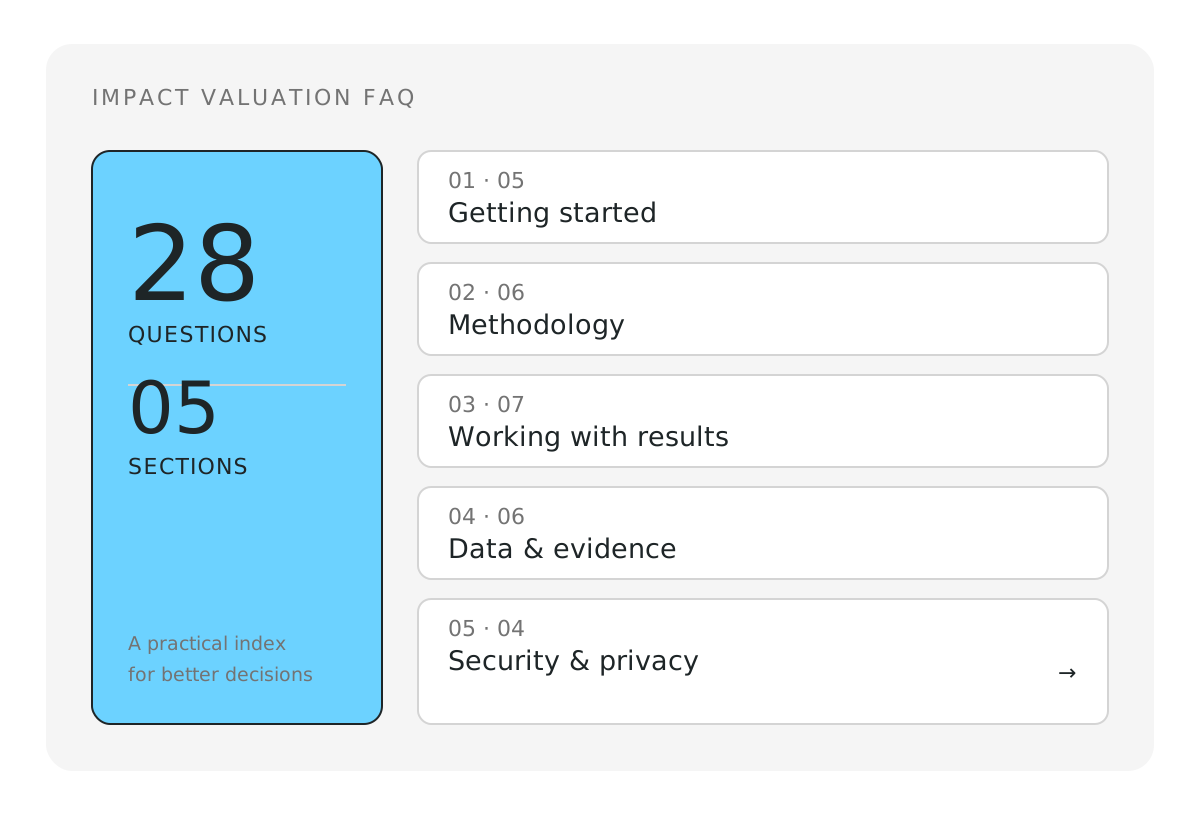
This FAQ explains how impactaccounting.ai can be used to assess organizations, investments, projects and portfolios, including the software's practical limitations.
1. Getting started
1. What does the software produce?
The software turns information about an organization or project into an impact statement covering human, social and natural capital. It identifies positive and negative impact pathways, estimates their societal value using the eQALY methodology, and shows the assumptions and evidence behind the results. The valuation is an estimate of societal impact, not a financial return or a prediction of future performance. Its usefulness depends on the quality, scope and comparability of the underlying assessment.
2. Does impact valuation replace ESG due diligence or impact management?
Impact valuation complements ESG due diligence by providing a quantified view of societal value, trade-offs and impact drivers. It does not replace assessments of governance, strategy, legal compliance, safeguarding or other management considerations. Existing ESG information, impact KPIs and operational data can be used as inputs, but an impact valuation should not be treated as the sole basis for an investment decision.
3. Can the software assess both organizations and individual projects?
Yes. Organization mode assesses a company or other operating organization, while Project mode can assess and compare specific investments, projects or programs. For a step-by-step guide, see Assessing and comparing investments, projects or programs.
4. What information is needed to begin an assessment?
An organization's name, website and a short description can be enough to create an initial assessment using public information. A limited starting dataset will usually result in more estimated assumptions and greater uncertainty, so the first model should be treated as a basis for review rather than a final answer. For a step-by-step guide, see Assessing an organization.
5. Does the methodology work across different sectors and business models?
The methodology is designed to work across sectors because pathways are built from the activities being assessed rather than selected from a fixed sector template. It becomes less precise when a single assessment covers a highly diversified group operating across many countries, sectors or business units. For example, assessing a multinational group as one entity may require assumptions that hide important differences between its agricultural, financial and logistics operations. Separate assessments by business unit or geography can provide greater precision.
2. Methodology
6. How are impact pathways defined, and how much do they vary?
An impact pathway is the causal chain connecting an activity to its outputs, outcomes and final impacts on people or nature. Pathways are created from the specific activities of the organization or project and linked to the assumptions and evidence used in their valuation. Similar business models may share common pathways, but each assessment should reflect the organization's particular products, stakeholders and operating context.
7. How is the assessment boundary defined, and how is additionality handled?
Each assessment defines the activities, stakeholders, geographies and reporting period included in the model. Pathways then consider what changed because of those activities and what might have happened without them, using available counterfactual or baseline evidence. The software can structure and quantify these assumptions, but it cannot prove causality when the underlying evidence is limited. Users should therefore review the boundary and additionality assumptions before relying on the final value.
8. How are baselines and customer outcomes estimated?
Baselines use the best available combination of information supplied by you, public disclosures, customer survey data, third-party impact data and scientific literature. Where direct outcome data is unavailable, the software can use a sourced estimate adapted to the organization's context, but an estimate is not equivalent to an observed customer outcome. For example, a lending assessment without customer-level evidence may estimate both financial-wellbeing benefits and borrowing-related stress using relevant research. Those estimates should be replaced or tested when better customer data becomes available.
9. Does the assessment include negative and unintended impacts?
Yes. The software is designed to identify both positive and negative pathways, including effects that may conflict with the organization's intended impact. For example, a lending product may improve access to finance while also creating repayment stress or financial dependency for some customers. Negative impacts can still be missed if relevant activities, stakeholders or value-chain effects fall outside the assessment boundary.
10. How are impacts converted into monetary societal value?
The eQALY methodology converts effects on health, income, education, social conditions and the environment into a common well-being measure and applies a consistent valuation factor. This makes different impacts comparable without treating the result as revenue, profit or cash generated by the organization. The monetary value is modeled societal value, and it remains sensitive to the underlying pathway assumptions. For more detail, see The eQALY method: value your first impact.
11. How should uncertainty and confidence levels be interpreted?
Uncertainty is recorded for individual assumptions based on the strength and relevance of their evidence. Pathway confidence reflects the least-certain driving assumption, so a material pathway cannot receive a high confidence level when one of its key inputs is weak. Geographic and time relevance may be shown separately and do not determine the pathway confidence tier. Confidence labels support interpretation, but they do not eliminate model risk or guarantee that the assessment boundary is complete.
3. Working with results
12. How should total societal value, gross positive and negative value, and SROI be interpreted?
Total societal value combines the positive and negative pathways included in the assessment, while gross figures show value created and value offset separately. Human, social and natural capital provide alternative views of where that value arises. SROI is a ratio based on the financial basis used in the assessment, so its denominator should be checked before comparing organizations. At portfolio level, SROI should be calculated from aggregated values rather than by averaging company-level ratios.
13. Can assumptions and alternative cases be tested?
Yes. Scenarios can test how different assumptions, operating conditions or counterfactuals affect an assessment without replacing the base case. For example, a lender could compare its base assessment with a scenario using a lower customer-income effect or a higher default rate. A scenario shows the consequences of selected assumptions; it is not automatically a forecast or probability-weighted outcome. For a step-by-step guide, see Building scenarios.
14. Who reviews and approves changes proposed by the AI?
The AI can research, explain and propose changes, but material model edits should remain subject to user review and confirmation. Changes to an individual assessment are made through that assessment's own chat, while portfolio chat is read-only and cannot save model edits. This distinction reduces the risk that exploratory portfolio analysis silently changes the underlying assessments.
15. Can companies or projects be compared and benchmarked?
Yes. Assessments can be compared by total societal value, human, social and natural capital, pathways, SROI, uncertainty and data quality. Comparisons are meaningful only when reporting periods, currencies, organizational boundaries and valuation scopes are reasonably aligned. A ranking may otherwise reflect differences in assessment scope rather than genuine differences in performance. For a step-by-step guide, see Building a fund or portfolio assessment.
16. Does the software provide a portfolio-wide view?
Yes. A workspace overview shows assessments side by side, while portfolio chat can validate comparability, analyze results and identify the holdings and pathways driving value or harm. For example, it can show whether most portfolio harm comes from one holding or is distributed across several companies. Investor-attributed results require recorded ownership percentages; the software should not assume that missing ownership means 100%. For a step-by-step guide, see Building a fund or portfolio assessment.
17. Can societal value be monitored over time?
Assessments can be updated on demand so that changes are reviewed before they affect the model. Scenarios can test expected changes, while separate reporting-period workspaces or exports can preserve year-by-year portfolio records. Monitoring is not fully automatic: new information must be supplied or retrieved, reviewed and incorporated into the relevant assessment. Changes in methodology or evidence should also be distinguished from changes in the organization's actual performance.
18. Can results and supporting data be exported?
Yes. A workspace can be downloaded with its structured assessments, results and supporting model files for external analysis or reporting. The export is a snapshot rather than a live connection, so it may no longer match the workspace if assessments are updated later. Export dates and model versions should be recorded when results are used in formal reports. For the available outputs, see Exporting results and regulatory outputs.
4. Data and evidence
19. What sources does the software use when internal data is limited?
The software can use organizational disclosures, financial and sustainability reports, public third-party sources, scientific literature and relevant social or environmental datasets. Missing information may be estimated from suitable external evidence, but it should be identified as an estimate and assigned appropriate uncertainty. Sources behind a login or paywall cannot be used unless access is provided. Public availability also does not guarantee that a source is current, independent or applicable to the organization being assessed.
20. Can an assessment be produced using public information only?
Yes, but a public-only assessment will often rely more heavily on inferred or estimated outcomes. In an anonymized lending assessment, removing customer survey data meant that the model had to rely on external evidence and more conservative assumptions about borrowing-related stress. This did not make the assessment unusable, but it increased uncertainty and made the result less specific to the organization's customers. Public-only and enhanced-data cases can be compared using scenarios.
21. What additional data most improves accuracy?
The most valuable data is the information that improves assumptions driving a material share of positive or negative value. Depending on the organization, this may include customer outcomes, product use, beneficiary characteristics, financial terms, environmental flows or operational volumes. Collecting more data does not automatically improve the assessment if it relates only to immaterial pathways. Sensitivity and scenario analysis can help determine which evidence is worth improving.
22. What do data tiers mean, and how can an assessment move to a higher tier?
Where data tiers are used, they indicate the overall maturity and evidential strength of an assessment. Moving to a higher tier generally requires more specific, recent and independently supported evidence for the assumptions driving material pathways. A higher tier does not mean that every assumption is directly observed or that the assessment has been externally assured. Improving low-impact inputs may add detail without materially strengthening the overall result.
23. How is new data added, and how often are models refreshed?
You can upload new documents or provide updated information through the relevant assessment chat. Proposed model changes are reviewed before they are saved, while scenarios can be used when the new information represents an alternative case rather than a correction. Models are not silently rewritten whenever a new source becomes available. Reference datasets and valuation factors can be updated as new versions are released, so reporting periods should be documented when comparing results over time.
24. Are impact assessment results independently verified or assured?
Not by default. The software provides inspectable assumptions, evidence trails and source citations to support internal or external review, but those features are not the same as independent assurance. An organization should arrange separate review or assurance where required by regulation, governance policy or public reporting standards.
5. Security and data privacy
25. How are privacy, cybersecurity and confidentiality protected?
impactaccounting.ai is operated by ViSoftware SA in Switzerland and is designed to meet Swiss FADP and GDPR standards, with data processing governed through appropriate agreements and contractual clauses. Access requires authentication, permissions are deny-by-default, and server-side checks are applied to protected routes and records. Files are not publicly accessible, traffic is encrypted in transit, and hosting providers encrypt stored data at rest. Workspace data is visible only to authorized members, while operational access is limited to service support and governed contractually. The software does not currently hold SOC 2 or ISO 27001 certification, and organizations requiring those certifications should consider this during procurement.
26. Who owns uploaded and generated data?
You retain ownership of the information you upload and the content generated in your workspace. The service receives only the rights needed to process that information and provide the software. Workspace data is not used to train AI models, and zero data retention at the model provider can be enabled on request. Analytics capture of AI interactions can also be disabled.
27. How is the use of AI models governed?
The software uses a pinned production model through the OpenAI API rather than a consumer AI product. Documents are indexed by project and queried only within the relevant analysis, while identifiers sent to the model provider are salted hashes. AI-generated outputs remain reviewable and editable, with evidence trails, inspectable assumptions and traceable citations. Prompt and model changes are regression-tested before release. AI outputs can still contain incorrect interpretations or unsuitable assumptions, so material results require human review.
28. How is data segregated between customers?
The software uses a multi-tenant architecture in which every record is linked to a workspace and permissions are enforced at the database layer. Server routes independently verify workspace membership, and AI document indexes are segregated by project. Customer data is not aggregated across organizations or used for model training. Organizations whose policies prohibit multi-tenant hosting should discuss whether a dedicated deployment is available and appropriate.